Guided Hike
Walking as a way of thinking, with somebody who knows the ground
Routes from an easy hour along the shoreline to a half day on the ridge. A guide sets the pace to the slowest person and nobody is made to feel it.
Conversation is optional in both directions. Some guests want the names of things and the history of the water, and some want to walk in silence for two hours. Say which at the trailhead and the guide will hold to it.
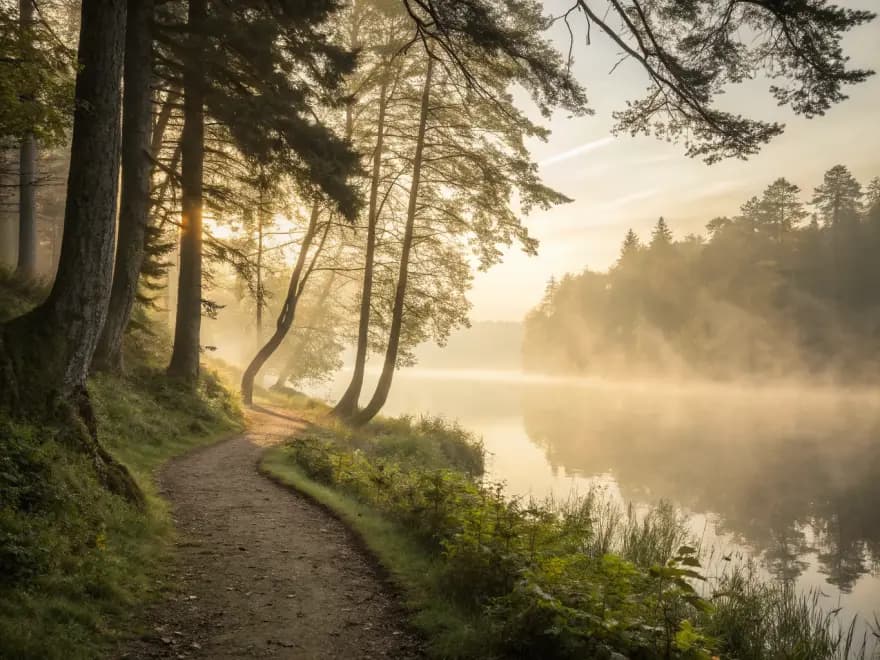
The ridge route in early autumn is the one worth planning a stay around. The light comes across the lake at an angle you do not get in summer and the whole valley reads differently.
The research
What studies have found
Nature experience reduces rumination and subgenual prefrontal cortex activation
Proceedings of the National Academy of Sciences · 2015
Rumination, the habit of repetitive negative thinking about oneself, is linked to higher risk of depression. In this study published in PNAS, healthy participants took a 90-minute walk either in a natural setting or in an urban setting. Those who walked in nature showed reduced self-reported rumination and reduced activity in the subgenual prefrontal cortex, a brain area associated with rumination, as measured by brain imaging. Those who walked along a busy urban route showed no such changes. The authors suggest this may be one pathway by which nature experience supports mental well-being, and that accessible natural areas could be an important mental health resource. One limitation is that the abstract does not report a large sample, and the participants were healthy adults, so the effect in people with depression is not tested here.
Shinrin-Yoku (Forest Bathing) and Nature Therapy: A State-of-the-Art Review
International Journal of Environmental Research and Public Health · 2017
Shinrin-yoku, or forest bathing, is the Japanese practice of spending mindful time among trees. This state-of-the-art review set out to gather empirical research on its physical and psychological effects, much of it from Japan and China, and to encourage longitudinal research in Western countries. Searching five databases, the authors started with 127 papers and included 64 studies published between 2007 and 2017, grouping them into physiological, psychological, sensory and framework studies. They conclude that the human health benefits of immersion in nature continue to be actively researched and suggest nature therapy as a possible health promotion approach for modern stress, including technology-related stress. The limitation is that this is a narrative review: it summarizes research but does not pool results or rate how strong each study was.
Spending at least 120 minutes a week in nature is associated with good health and wellbeing
Scientific Reports · 2019
Using a nationally representative survey of 19,806 people in England, researchers examined whether the amount of recreational time spent in nature during the previous week was linked to self-reported health and well-being. Compared with people who had no nature contact that week, those who spent at least 120 minutes in nature were significantly more likely to report good health and high well-being. Benefits peaked at around 200 to 300 minutes a week, with no further gain beyond that. The pattern held across groups, including older adults and people with long-term health conditions, and it did not matter whether the time came from one long visit or several shorter ones. The key limitation is that this was a cross-sectional survey, so it shows an association, not that nature time caused better health.
Compose a stay around it
Pick your nights, choose who guides you, and see the whole retreat on one ticket before anything is charged.
Build your retreatOther experiences